
THE 90° RULE
Stun it
Hit the object ball with no topspin or backspin and the two balls part at a right angle.
See the rule doodlebilliards
THE GEOMETRY OF A GOOD SHOT
Where the cue ball goes next is not luck. It is geometry.
Check the ball values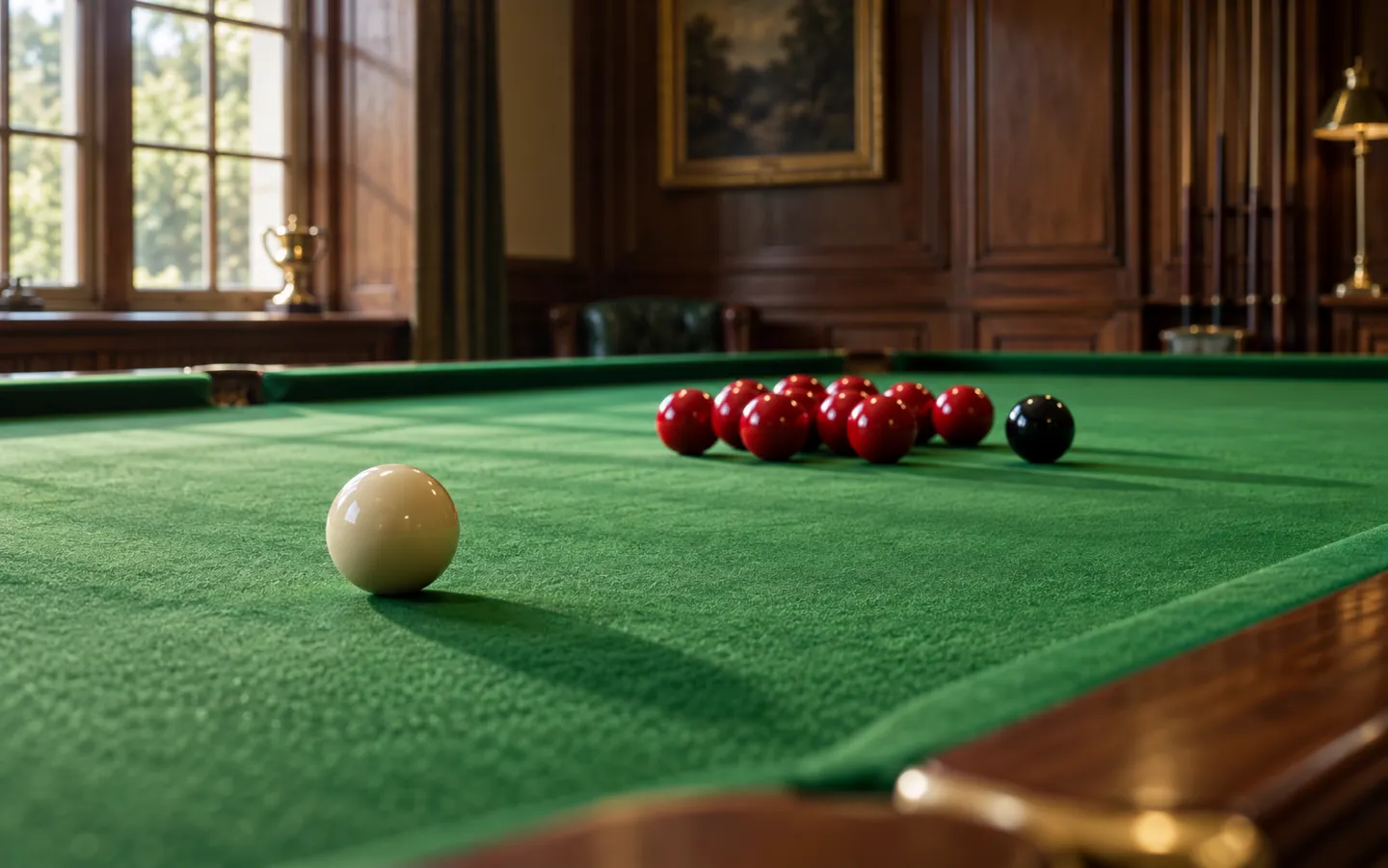
90° · 30°stun or roll
Two simple rules from the physics of colliding balls tell you where the white will travel after contact, and the scoring of snooker rewards anyone who can predict it. Here are the angles, the numbers and a little history, in plain English.
Plain English, with the sources linked.
Updated
THE SHORT ANSWER
Two angle rules and one scoring table
explain most of what happens on the cloth.
THE 90° RULE
Hit the object ball with no topspin or backspin and the two balls part at a right angle.
See the ruleTHE 30° RULE
With natural roll, the white turns about 30° from its path across a wide range of hits.
How it worksTHE SCORE
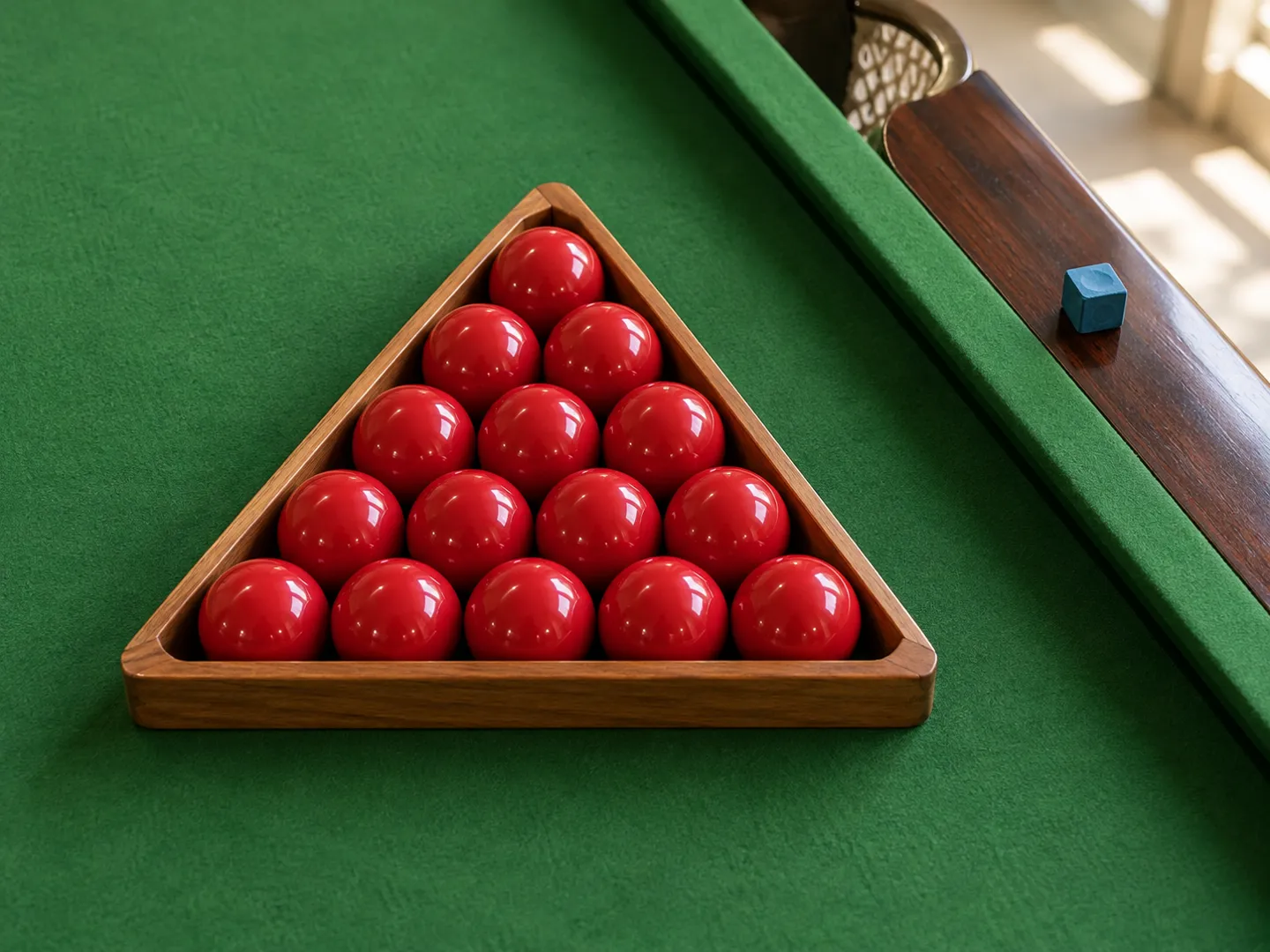
Fifteen reds worth 1 and six colours worth 2 to 7 make a maximum break of 147.
Check the valuesA QUICK BALL CHECK
Pick a ball to see its value in snooker. The values and the order of play come from the official rules of the World Professional Billiards and Snooker Association.
A break is the run of pots a player makes in one visit to the table. The bigger the colour after each red, the faster it grows.
TWO RULES WORTH KNOWING
The same contact point sends the white
in different directions, depending on how it is moving.
90°
Angle between the two balls after contact
When the cue ball strikes an object ball with no topspin or bottom spin, the two balls separate at a right angle. The rule is exact only for a stun shot, where the cue ball is sliding, not rolling, at impact.
STUN · THE 90° RULE
≈30°
Turn in the cue ball's path with natural roll
With natural roll, the cue ball's new direction stays fairly close to 30° from its original line for hits from about a quarter-ball to a three-quarter-ball. A half-ball hit, in which the cue ball's centre aims at the object ball's edge, gives a 30° cut.
ROLL · THE 30° RULE
Both rules come from the physics of two equal balls colliding. Real shots drift from them a little, because of friction between the balls and cloth, but they are a reliable starting point for where the white will end up.
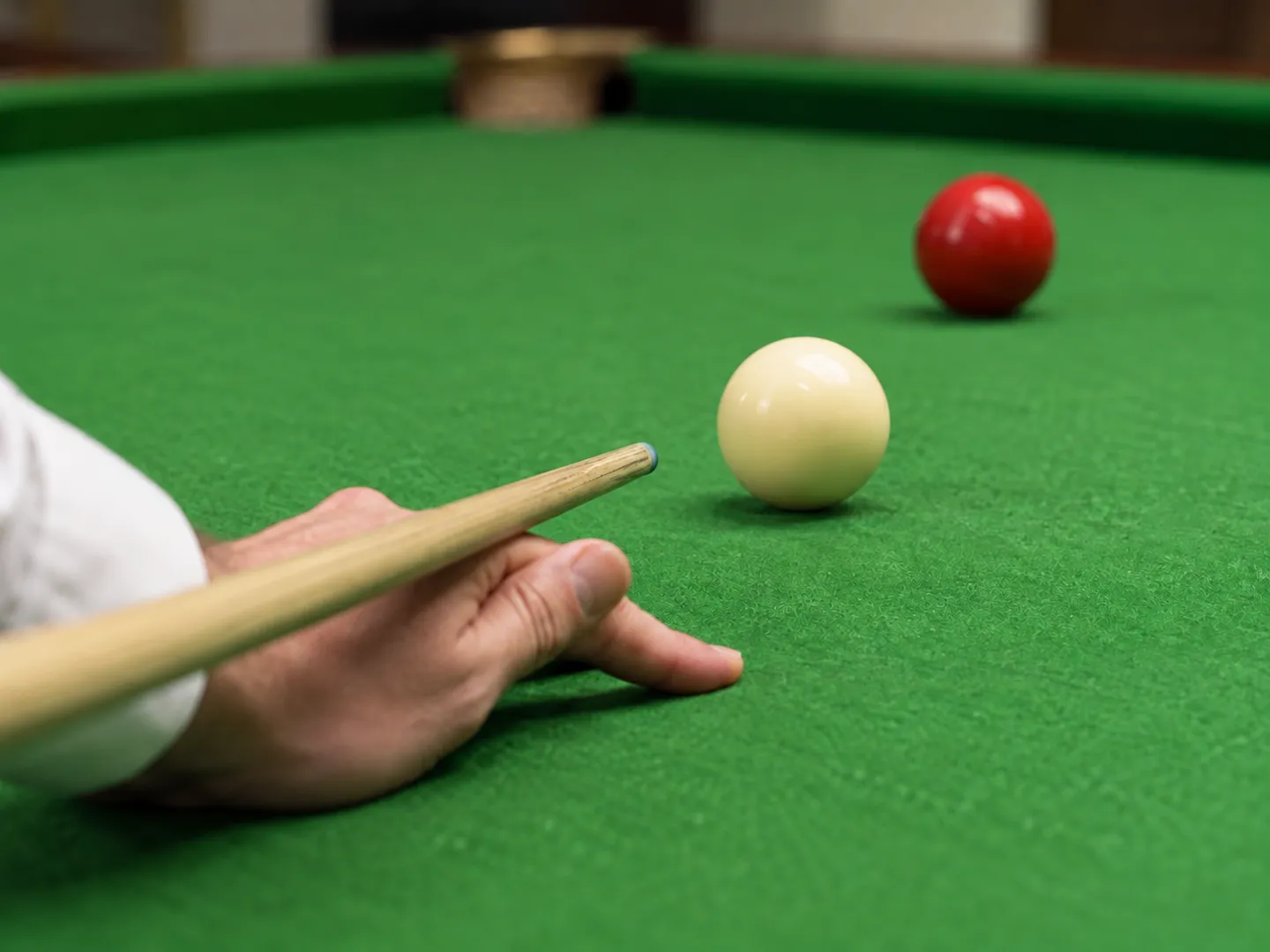
TRY IT NEXT FRAME
Strike the white near its centre so it slides into the object ball, then watch it leave along a line at right angles to the object ball's path.
For rolling shots, hold up two fingers in a V from the cue ball to picture the roughly 30° line the white will take after contact.
After each red you pick the colour. Pick the one that leaves the white best placed for the next red, not only the highest value.
Count each visit out loud. A red and a black add 8 at a time, so it is easy to see how a long break builds.
TABLE FACTS
In 1835 the French mathematician Gaspard-Gustave de Coriolis published Théorie mathématique des effets du jeu de billard, a mathematical theory of the game of billiards.
In 1863 a New York firm offered $10,000 for a substitute for ivory billiard balls. John Wesley Hyatt saw the advert and patented celluloid in 1870, though he never claimed the prize.
The WPBSA records that snooker was invented in 1875 by the British Army in Jubbulpore, now Jabalpur, in central India.
Joe Davis made the first officially recognised maximum break of 147 on 22 January 1955, in an exhibition match.
A full-size table's playing area is 3569 mm by 1778 mm, give or take 13 mm, and each ball must be 52.5 mm across to within 0.05 mm.
QUICK QUESTIONS
Short answers to the questions people ask most.
When the cue ball hits an object ball with no topspin or bottom spin, the two balls separate at 90 degrees. It holds exactly only for a stun shot, where the cue ball is sliding rather than rolling at the moment of impact.
When the cue ball is rolling naturally, its new direction after contact stays fairly close to 30 degrees from its original path across a wide range of hits, from about a quarter-ball to a three-quarter-ball hit. It is a rule of thumb, not exact.
There are fifteen reds worth 1 point each. Taking the black, worth 7, after every red gives 15 × 8 = 120. Then the six colours are potted in order for 2 + 3 + 4 + 5 + 6 + 7 = 27 more, making 147.
Under the WPBSA rules, the playing area inside the cushions measures 3569 mm by 1778 mm (11 ft 8½ in by 5 ft 10 in), with a tolerance of 13 mm, and the balls are 52.5 mm across, to within 0.05 mm.
According to the World Professional Billiards and Snooker Association, snooker was invented in 1875 by officers of the British Army in Jubbulpore, India, now Jabalpur.
A NAME WITH ANGLES
It is not open for bids or leasing right now. Browse the catalogue for names you can bid on or lease today.

